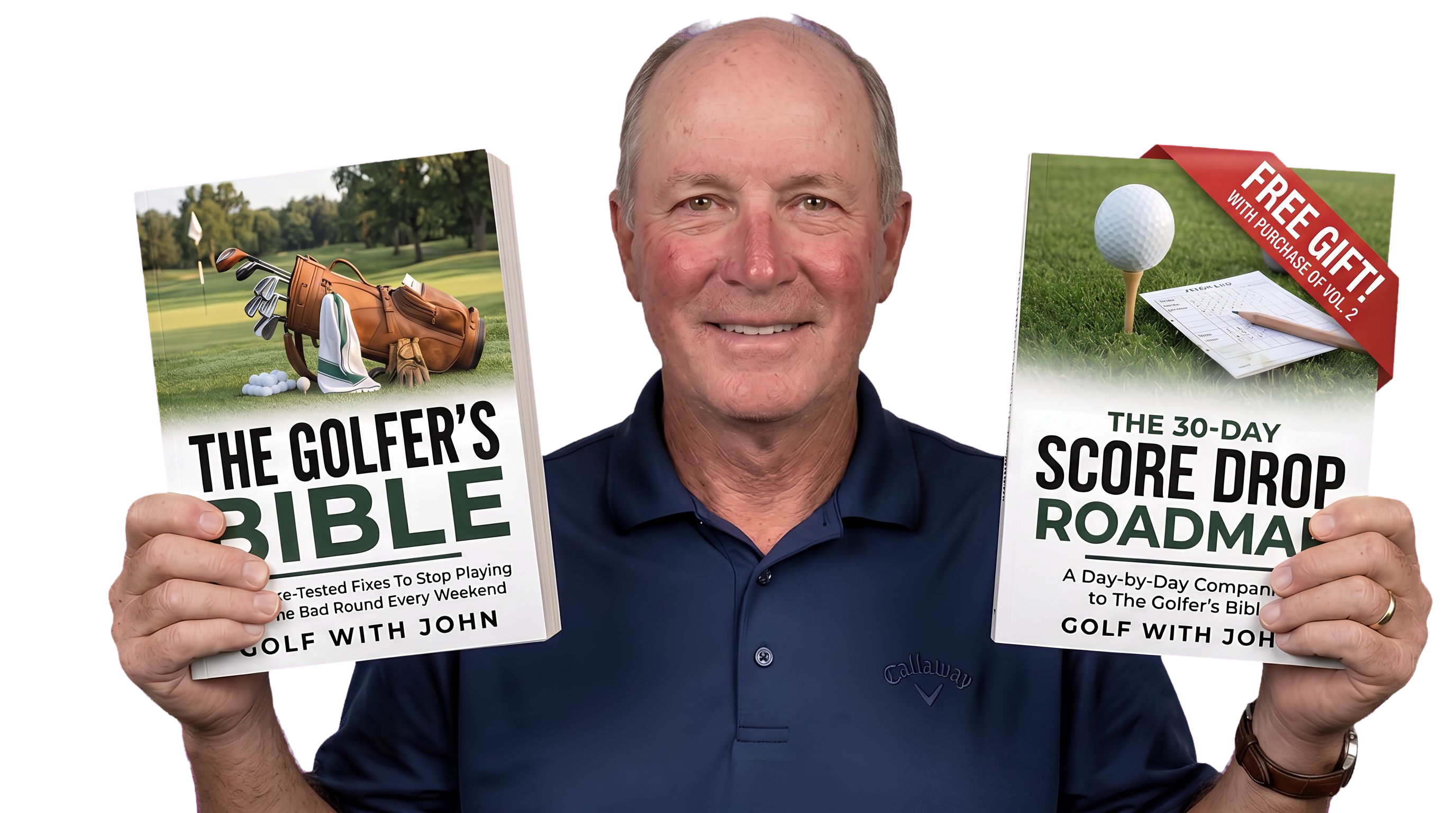
You don't need another swing overhaul. You need to stop 3-putting, stop the disaster holes, and stop guessing your yardages. 101 fixes across 383 pages, organized by the pain that's actually killing your scorecard.
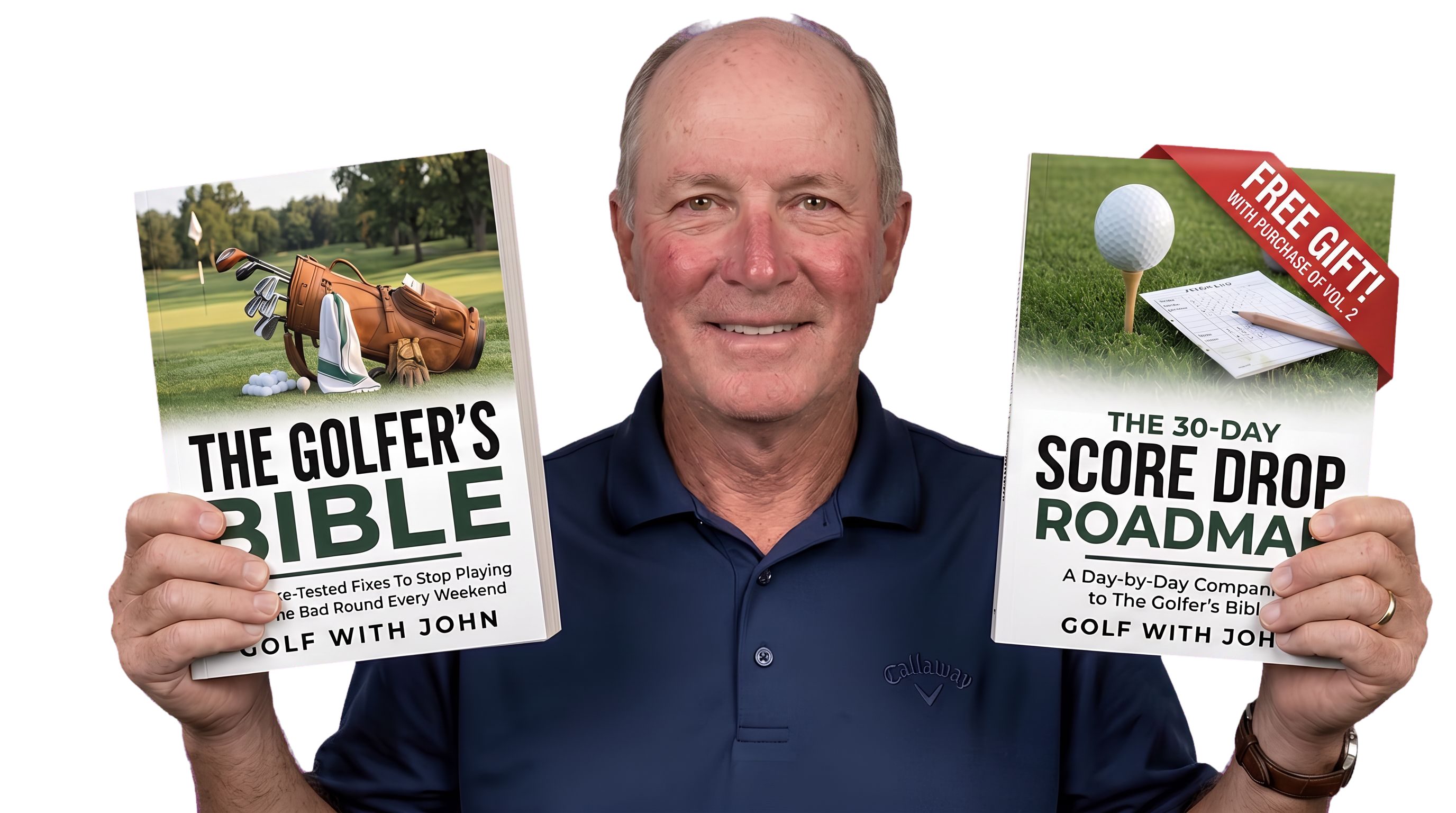
The Golfer's Bible ($74) + Score Drop Roadmap ($29) — bundled together for $29.99.
Get Instant Access — $29.99You shoot 91. Then 89. Then 94. Then 90 again. Same round, different Saturday, for three straight years. You've spent real money on lessons and equipment and none of it moved the number, because the number was never a swing problem to begin with.
One bad drive turns into a hero shot through a 4-foot gap in the trees, which turns into a chunk, which turns into a 7. You didn't lose the hole on the tee box. You lost it on the second decision.
You hit a great approach to 20 feet and still walk off with a bogey because you never learned to read the break or control your speed. It happens three or four times a round and you've stopped even being surprised by it.
You stand over a 60-yard wedge with no real number, just a feeling, and the ball comes up 15 yards short every single time. There's no system, so there's no consistency.
You've paid for a season of lessons and your handicap hasn't moved a single stroke. The pro fixed your takeaway. Nobody talked to you about the decisions that actually cost you strokes.
You aim dead center at the fairway with a swing that fades 15 yards every time, and then act surprised when it finds the hazard on 14. Your aim never accounted for your own dispersion.
New driver, new irons, new putter, and you still walk off the 18th wondering what happened. Equipment can help, but it was never going to fix a decision problem.
The 18-handicap golfer does not get to 12 by fixing his swing. He gets there by changing his decisions, his equipment, and the way he thinks about a round of golf.— THE GOLFER'S BIBLE
Every fix follows the same structure: the problem you recognize instantly, why it costs you strokes backed by real data from Pelz, Broadie, and Hogan, and the better move you can use on your very next round. No fluff, no theory you can't apply on Saturday morning.
Cut one double bogey per round and drop four strokes off your scoring average without touching your swing. This is the single highest-leverage chapter in the book.
A hard, objective test for whether a recovery shot is smart or suicidal. Stop negotiating with yourself in the trees.
Green reading, speed control, and a pre-putt routine that actually holds up under pressure. This chapter alone is worth two strokes a round for most 90s shooters.
Replace guesswork inside 100 yards with a clock-based distance system you can trust under pressure. No more chunked 60-yard wedges.
Aim where your ball actually goes, not where you wish it went. This single mindset shift takes water and OB out of play on half your rounds.
Turn automatic bogeys from greenside sand and deep rough into routine up-and-downs with a repeatable technique, not luck.
Where to aim off the tee, when to lay up, and how to build a hole-by-hole game plan before you ever step on the first tee.
What a real fitting checks that a big-box demo day never will, and which clubs in your bag are quietly costing you strokes.
Rotella-tested routines for staying out of your own head after a bad hole so it doesn't turn into three bad holes.
Why range perfect and course terrible are connected, and the specific drills that close that gap for good.
Knowing the 101 fixes isn't the hard part. Applying them in the right order, without overhauling your entire game at once, is. Score Drop Roadmap is a 30-day plan that tells you exactly which fixes to work on each week so you're not trying to change twelve things on Saturday morning.
This is the full fix, not a sample. The complete 101-fix book plus the 30-day roadmap that tells you what order to apply them in.
Real readers, real handicaps, real scorecards. Results vary, but the pattern doesn't.
"I'd been stuck at a 19 handicap for four years despite lessons every spring. The disaster holes chapter alone got me to stop making bogey into double. I'm a 14 now, six months later."
"The wedge distance system fixed the one thing three different instructors never addressed. I stopped chunking 60-yard shots almost overnight. Wish I'd had this ten years ago."
"I read it thinking it would be another swing book. It's not. It's decisions, and mine were terrible. Dropped five strokes off my average without one range session."
"The three-putt chapter should be required reading. I went from four three-putts a round to maybe one every other round. That's four strokes I just don't lose anymore."
"I've bought every training aid on the market. This cost less than a sleeve of balls and did more for my score than any of them. Broke 90 for the first time in three years last month."
"The roadmap kept me from trying to fix everything at once, which is exactly what I would have done. Followed it for a month and my handicap dropped two full strokes."
It's a digital PDF you can read on your phone, tablet, or computer, or print at home. You get instant access right after checkout, no shipping and no waiting.
Lessons fix your swing mechanics. This book fixes the other eleven variables that determine your score: decisions, course management, distance control, and routine. Most golfers between 85 and 100 need this more than another swing tweak.
Every fix is course-tested and sourced from real data, including Dave Pelz's scoring research and Mark Broadie's strokes-gained studies out of Columbia Business School. It's built to be applied on your very next round, not filed away.
If you shoot between 85 and 105 and have plateaued for a year or more, this is written directly for you. Low single-digit players and total beginners will get less out of it.
Score Drop Roadmap is a 30-day companion plan that tells you which of the 101 fixes to apply each week, so you improve in order instead of trying to change everything at once. It's included free with today's order.
By pain, not by swing mechanics. When you walk off the course after another 92, you open the chapter that matches what actually hurt you that day, whether that's three-putts, disaster holes, or bad wedge distances.
No. Most of the 101 fixes are decision, routine, and technique changes that cost nothing. There's one chapter on equipment fitting basics, but it's not a requirement for the rest of the book to work.
You get 30 days to read it, apply it, and play with it. If your scorecards don't show it, email us and we'll refund you in full, no questions asked.
You already know your swing isn't the problem. 101 course-tested fixes are waiting to show you exactly what is.